Roast Pork for Two
By Jessica – March 20th, 2006
Roasting meat should be the simplest thing in the world: you take a piece of meat and cook it in the oven until it’s “done”. But every time I intend to roast something, I find myself searching for definitive guidelines on how to do it right - and every time, I encounter two main problems.
Firstly, most cooking guidelines encourage you to cook your meat to death in order to prevent “food-borne illness”. While this is a reasonable concern, overly-cautious recipes are not very helpful if you want a tender, juicy roast instead of a dry, grey lump. And secondly, most recipes for roast meat are designed to serve six people or more, which is a bit awkward if you just want a small roast for two.
Roast pork is particularly vexing. Undercooked pork is dangerous, overcooked pork is dismal, and when you’re dealing with a tiny 1-pound piece of meat, it’s impossible to get that layer of crunchy crackling and the caramelized pan drippings that only accumulate after long, slow roasting. But good roast pork is also delicious, so I resolved to figure out how to turn a small pork loin into a proper (easy) Sunday roast. Here’s what I came up with.
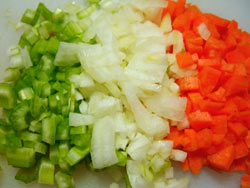
To make Roast Pork for Two, you will need:
- 1/4 cup each finely diced carrot, onion and celery
- one large bay leaf
- one piece boneless pork loin, about 500g (1lb), covered with a thin layer of fat
- 1 1/2 cups beef stock (I just use a beef stock cube dissolved in hot water)
- 1 tablespoon butter
- 1 tablespoon flour
- 1 splash red wine
Preheat the oven to 190C (375F).
Layer your finely diced carrot, onion and celery in the bottom of a small roasting tray and put the bay leaf on top. These vegetables will soften and get lightly browned during roasting, which will give some depth to the gravy you’ll make with them at the end.
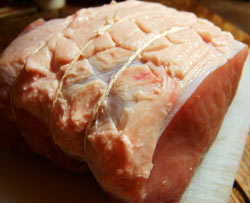 If your pork loin is wrapped with the strangely elasticized string that mine always comes wrapped with, take that string off. Score the fat on the loin in a crisscross pattern and season the whole loin lightly with salt and pepper. You can re-wrap your loin with fresh cotton string so that it holds its shape, but the world won’t come to an end if you don’t.
Heat a frying pan over medium-high heat. Don’t use a non-stick pan; you kind of want bits to stick and get brown in the skillet. Put your meat fat-side-down in the pan and sear it until the outer layer of fat is brown and crispy (this is what will give you an approximation of crackling). Then sear the other sides of the loin until it’s nicely browned all around. This only takes a few minutes, and it makes all the difference between an uninteresting grey roast and a mouth-watering golden one.
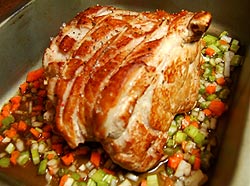 Remove the pork from the frying pan and place it fat-side-up on top of the bay leaf and vegetables in the roasting tray. Rub some coarse salt into the fat and all around the outside of your meat; I use Hawaiian sea salt, which seems to have a particular affinity with pork (or maybe it’s my imagination), but any coarse-grained salt will do.
Add about 1/4 of a cup of your beef stock to the frying pan and stir it around to get up any crunchy brown bits left in the pan. Pour this stock over the vegetables in the roasting tray and add another 1/4 cup of stock to the tray so everything is nice and moist, but not swimming. Put the tray in the oven and roast the whole lot for about 40 minutes, until a meat thermometer stuck in the middle of the loin registers 63C (145F).*
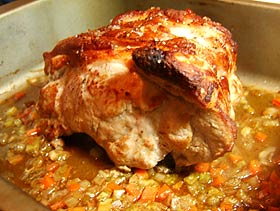
Take the tray out of the oven, then take the pork out of the tray and put it on a platter. Cover the pork loosely with foil and let it sit in a warm place while you make your gravy.
For the gravy, melt 1 tablespoon of butter in a small saucepan. Stir in 1 tablespoon of flour, then whisk in the juices (along with the vegetables and bay leaf) from your roasting tray. Add another 3/4 to 1 cup of beef broth to the saucepan, along with a splash of red wine. Simmer until the gravy has thickened (5-10 minutes), then season to taste. You could strain out the vegetables if you want a smoother sauce, or you could puree them (after removing the bay leaf!) to get a thicker sauce, but I just leave them as they are and enjoy the texture they add.
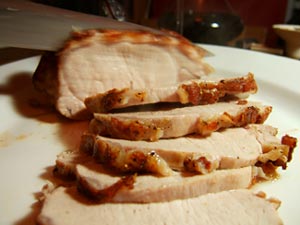
By the time your gravy is done, your pork will be ready to go. Carve it into medium-thick slices and serve it with the gravy, some nice sauteed cabbage and roasted carrots, and a fruity pinot noir.
*Disclaimer:
The official line on cooking pork is that the internal temperature should be at least 71C (160F). If you want to be completely, utterly safe, then I recommend you cook it to that temperature.
However, the bad stuff (trichinella spiralis) that could potentially lurk in pork is not only fairly rare these days, it’s also killed at an internal temperature of 58C (137F). Also bear in mind that pork loin is a very lean cut of meat: there’s no marbling of fat inside to keep it juicy when cooked to an internal temperature of 71C (160F) or higher. I find that cooking pork loin to a temperature of 63C (145F) and letting it rest for 10 or 15 minutes results in meat that is tender, pearly white, fairly moist and definitely thoroughly cooked. If you buy good meat (ideally, organic and free range) and handle it properly, then your chances of getting ill from pork are quite slim indeed.
In any case, I definitely recommend purchasing an instant-read meat thermometer if you don’t already have one. It’s much safer and easier to accurately check the internal temperature of your meat than it is to poke and prod at your roast in an effort to determine whether the juices are “running clear” or not.
Comments
You know, whether I’m going to make the food or not, I dearly enjoy reading about the process and getting to view the delectable photos!
Thank you very much! That’s exactly how I feel about cookbooks: there aren’t enough days in the year for me to be able to make all the recipes in all the cookbooks I have, but I love just looking through them anyway. I guess that’s why they call it “food prí ¸n”. :-)
Looks yummy and your take on the bed of vegetables (matignon) is an interesting one and something I’ve never thought to try.
With regard: "when you’re dealing with a tiny 1-pound piece of meat, it’s impossible to get that layer of crunchy crackling" I solve this by scoring the top quite finely with a serrated tomato knife, pouring some boiling hot water over the skin and then really working in some salt, followed by an initially high temperature in the oven.
Also the other thing to consider is removing the crackling once the pork is cooked and continuing the [slow] cooking on a rack of some kind so that the fat drips off.
My other thought/tip/pref is always cook meat on the bone it will have more flavour.
And of course I come with tales of pork cookery from days of yore. Many many arguments I have had about pork cookery with older customers, who panic at the sight of juice oozing from a piece of pork. It’s simply not as dangerous as it was, and if it’s run of the mill supermarket stuff it’ll be loaded with antibiotics anyway so it’s more likely to cure an illness that cause one!
Thanks very much for your tips on roasting pork, John - I cherish the opportunity to get hints from a professional chef! I’ll try the boiling water method next time - and next time I’ll also look for meat with the bone in.
I guess old habits die hard, and if you’ve always been told that pork is dangerous unless it’s cooked until it’s hard and grey, you’re going to balk at something that looks underdone. Even I hesitated over some of the pork I was served during my years in Germany - where they eat a lot of pork, and they eat it very pink indeed. But a bit of rosiness and a lot of juice are just lovely…
I have been doing the boiling water trick on pancetta before I add it to a pasta sauce and it makes all the difference in world.
((Now to reveal my REAL inner geek)) My first cookbook when I was ten, was the Little House on the Pairie Cookbook. One of the recipes was for Pork Cracklins - which was take bacon or larding, simmer it with 1/2 cup of water until the water is cooked off and so it most of the fat (about 1/2 hour) and what is left is delicious, fabulously crispy pork bits. This also works with pancetta that is fatty and somehow most of the pancetta brine/pepper flavor stays through the process.
I really never would have thought that boiling water would make bacon or pork fat crispy - I must try this!
“My first cookbook when I was ten, was the Little House on the Pairie Cookbook.” :-)
Mine was something like “Cooking Fun for Kids”. I seem to recall it had recipes for making grilled cheese sandwiches in funny shapes and things like that - no pork cracklins, though!
This sounds wonderful. I have never been able to get pork loin right, as my wife can atest. However, I am always trying to cook the perfect roast no matter if it is beef or pork. I think I will give this a try this Sunday.
I’d second the recommendation to take the skin off about halfway through cooking, suspend it over some sort of grill and continue cooking.
This was my mum’s tried and tested method for my entire childhood — she would typically drape the skin over a couple of criss-crossed wooden spoons. Tt has the other bonus side-effect that the remaining small layer of fat on the pork itself once the skin/crackling layer is removed also browns nicely.
I gave this a try and it was fabulous. I tried it with a 3 1/2 lb piece of pork because I had more poeple to feed, so it took about 70 minutes to cook. I removed the meat from the oven once the internal temperature was 145 degrees and then let it rest as you suggested.
The only problem I had was that the stock evaproated very quickly so I had to keep adding liquid to make sure the vegetables didn’t burn.
I served it with garlic mashed potatos. Everyone raved about how moist and tender everything was. Great receipe. Phoenix gives it two thumbs up.
Yay, I’m so happy to hear that! Yes, I guess with a larger piece of pork that has to cook longer, you would have to up the amount of liquid accordingly. But a bit of crispy caramelization on the veggies probably isn’t a bad thing either!
Dear Jessica,
We have just finished another delicious roast pork meal, made to your specifics. It is absolutely delicious! The vegetables underneath are simply divine and add so much flavour to the overall meal. I add potatoes and pumpkin around the pork which soak the flavour of both pork and vegies. Simply marvellous!
Thanks so much Jessica. I will now return to drinking with my guests who are raving about this delicious meal.
Saluti! Cheers!
Thank you, I’m so glad you’ve enjoyed the recipe! Pumpkin sounds like an absolutely delicious addition - I’ll definitely have to try that this autumn…
Although I can not give you anymore secrets to the hidden pig, I will say you saved me from running out and picking up more vegtables for my pork loin tonight…carrots, celery and onion…all things I have on hand.. thank you and such for your wit made me laugh before supper
Recipe looks great! However, I must respond to the statment: "If you buy good meat (ideally, organic and free range) and handle it properly, then your chances of getting ill from pork are quite slim indeed."
The risk of trichinella spiralis is no less in organic or free range pork. Also, current research shows that there appears to be no health benefit to doing so as well. Do so only if it makes you feel better.
Just doing it now on "my first roast" in between work, shopping and collecting wife from hospital… did not think about time frame when in supermarket. will keep you informed on if the house burnt down. by the way, forgot to sear all sides of the roast, did that in the non-stick-pan, have not got selery, have NOT got thermometer etc etc looking forward to a result hopefully a good one!
This was exactly what i was looking for. simple, step by step and easy too do! life saver!
Tried your recipe yesterday,it was perfect,the veggies on the bottom was a great idea,as there are only two of us,it was great to find a recipe for two.Our roast was 2lbs,just doubled the time.
hope you have one for beef. Thanks
Michael, I do pretty much the same thing for beef: season it, sear it in a frying pan, smear it with some mustard, and then roast it until the internal temperature reaches about 125-130F (for rare beef).
You can do the same thing with the veggies, though you might want to cook the veggies in the oven a bit before adding the beef, since you’ll probably cook the beef for a shorter time than the pork.
Tried your beef recipe sunday 25,was another super meal. Thanks Jessica
Jessica: Thank you so much for this recipe. I went on a quest to find a recipe like this after I ruined 3 pork roasts by overcooking them! I tried this recipe last night with great success. It only took 30 minutes for the meat to reach 145F, and it was still nice and juicy. And no food poisoning! Next time, I will use low-sodium beef broth, but that is the only adjustment I would make.
I made this today. WOW was it juicy. Some of it was a little pink and it appeared that perhaps some parts of the pork where a little too pink. I had a digital thermometer stuck into what I thought was a thick side. It was a "long" 1.5 lb pork loin. Actually maybe even a little less than 1.5 lbs. It was very very good!!!!!!!
I forgot to mention: The gravy was to die for. Yummmmy!!!
further to taking the rind off the pork,by all means. Having done that then place a layer of breadcrumbs mixed with mustard and honey (or your own choice!)over the exposed joint. Return the joint to the oven and finish roasting. Yum-Yum yummy!
The magic of cooking! I made a pretty excellent roast out of your suggested temperature. Mine was still pinkish…. It was melting in our mouths!!! The pork came from a grocery store in Quebec (that came from USA)… Nevermind the trichinella spiralis..there is a lot of hospitals around ….You made our evening. Cheers Jessica!!!
THANK YOU!! I HAVE BEEN COOKING FOR 25 YEARS AND I CANNOT COOK A PIECE OF MEAT WITHOUT TORTUREING IT. I CANNOT THANK YOU ENOUGH FOR ALL THE INFORMATION. NOW WHEN ARE YOU GOING TO GIVE US THE TIPS ON HOW TO COOK A BEEF ROAST? JUST KIDDING. THANKS SO MUCH.
I have a small 1.5 lbs pork roast in the fridge and this sounds perfect for tonight - thanks! In an effort to avoid stopping at the grocery, does anyone have thoughts on using chicken stock instead of beef? Thanks, lazy j.
“food-borne illness” Always use, and recommend the use of a meat probe thermometer. A core temp. of 74 degrees Celsius (165 degrees F) maintained for 2 minutes will ensure safe meat. Go to 80 degrees for Pork to be sure, and 85 - 90 for poultry.
Sound great, will try tonight. I agree with your Food-Borne Illness thesis , provided your Immune system is not comprised Paul
Just found your blog tonight, and this recipe is amazing! I made both the roast featured here and the roasted carrots linked. We went apple picking today, so I served it with some baked apples. The gravy was the best - I was eating it with a spoon in the kitchen during post-meal clean up. Thanks! I’ve bookmarked you and look forward to more good meals ahead.
made this today and it was wonderful! thanks for sharing and this will be the way I prepare roast pork from now on.
Absolutely loved this. Thanks for the clear and cheerful directions!
Robert
thank you for this the only question is what if they come out wrong?
Delicious. Tried this tonight, with a few variations… but searing the roast before-hand made this meal simply scrumptious.
Thank you for posting this!!!
All you need to do is to coat the chicken by rolling them over the seasoning mixture.
When a coating such as bread crumbs are applied to the meat the flavors and coating will cover a greater amount of the meat’s surface offering more of these flavors per bite. Place 1-2 pieces of chicken at a time in the Ziploc bag containing the crunchy coating mix and shake until the chicken is well coated.
THANK YOU!!! I had never made roast pork before and was becoming disheartened by all the instructions online for massive cuts of loin. This was just the right temperature and timing for a perfectly succulent one-pound roast!
Thank you for your extremely clear and complete recipe for cooking such a small roast. I am trying it tonight!
Just made this and it was absolutely delicious. Only took 30 mins with my small roast. I changed it up a just a bit. Made in cast iron skillet. Took roast out after browning. Then added mirapoix with a little garlic. Returned pork to pan so that crackling was on top. Mounded mirapoix around it and added sweet potatoes. Check temp after 30 mins ( was already at 160 deg) Removed roast pork, covered it with foil. Removed sweet potatoes, covered to keep warm. Mixed 1 tbsp of corn starch with 1/4 cup of corn starch. Put mirapoix in ricer and pressed through several times. Added corn starch/ beef broth to pan, warmed through and added riced mirapoix back to pan. Added a splash of white wine. Too die for. Moist and flavourful. Thanks!!!!
This will be my new go-to pork roast recipe. Succulent pork. I substituted tapioca starch for flour and olive oil for butter when making the gravy due to having to be gluten free and dairy free but it was a very nice gravy. THANKS!
Most delicious small pork roast dish ever. Thank you, thank you, thank you. We buy a large pork loin and cut it into 1lb pieces. This recipe works well not dried out and the gravy is delicious. I put the veggies into a small processor to make it smooth. Then the left overs go to the dog. I swear she knows when I make it and cruises her dog bowl the whole time making/eating.
I have made this roast pork recipe a lot and never thought to praise you on such an easy, tasty, fabulous recipe. It is always tasty and succulent! The Mirapoix makes a perfect bed for the pork. I put half of it in a food processor and add to the gravy then rest the sliced pork on the mixture for a lovely, tasty presentation. Fanbloodytastic!
Excellent step-by-step directions. The vegetables in the gravy were very flavorful. The best part, then pork cooked at 375 to an internal temp od 140 degrees came out very moist! Not always something with such asmall piece of pork loin, a notoriously dry cut of pork. Thanks for a great recipe.
I like to put a dampened dry mustard rub and randomly insert cloves. Remove cloves after the cooking is done.
Wow! This was amazing! My hub and I could not believe the tenderness and flavor. The gravy was superb! I almost skipped the gravy, as it was late, and my gravy usually comes out blah! This was great, loved your directions. Thank you so much!
You’re very welcome, Mary, I’m so glad it turned out great!
The roast loin i conjured for sweetie and myself was wonderful. Crisp golden outer with a juicy and tender center. Do have any more “for two” recipies?
vincent michaud St. Lina, Alberta, Canada
Well, I am making this now. Followed the recipe as written. There is no liquid so there will be no gravy. We will see if the pork is edible. What a disappointment! I will probably have to throw it away!
Amazing that you posted this recipe 12 years ago and, like me, people are still finding and enjoying it. Made it tonight. Added a garlic clove to the mirepoix and used an immersion blender to make the gravy a little smoother. Delicious!
@Linda - I’m amazed too, actually! I’m very glad you enjoyed it, and your addition of garlic is a very good idea!
Hi, second time I made the roast….......Both delicious….....I increased veggies and browned them after the pork….....On a diet, avoided the gravy. Veggies with pork are so good. Thank you.
Dot…you could add more broth to the pan with the veggies and roast if it dried up. And then you add more when you make the gravy at the end. The recipe works perfectly if followed exactly. I’ve made it at least 3 times for New Year’s. We double it all so we’ll have some for leftovers. Love it!
My effort turned out way too salty but the roast was a great success. I will make it again without all the salt recommended or a different condiment.
Here is, 15 years later. I stumbled upon this recipe and saw positive comments reaching into 2019 and had to add my two cents. This came out BEAUTIFULLY. Every single one of us (incl the fussy 10 yr old and the picky almost-4) ate WAY TOO MUCH so there were hardly any leftovers. Served with some instant mashed potatoes and sauted baby greens. To. Die. For. I have already forwarded this link to all my favorite cooks and will be making this again soon!
Thank you, Sara, I’m so glad your whole family enjoyed it!
thanks for the recipe. Maybe, points are needed. bahsegel
I bought a full loin and cut it into pieces for the freezer. The piece I wanted to use today was just almost 2.5 lbs. I followed the instructions exactly allowing for some extra time for the extra weight. It turned out perfectly. Delicious. I also followed instructions of John Oxton for the crackling - it worked perfectly - first time ever! It was so good, and the gravy was excellent. Thanks for the post.
Hi, I so enjoy this recipe; its a regular in my diet. So easy to make. I increase the vegies, add garlic, peppers or squash and braise the veggies after the meat. This adds tremendous flavor. Thank you for a fan favorite.
Sorry. Comments are closed.